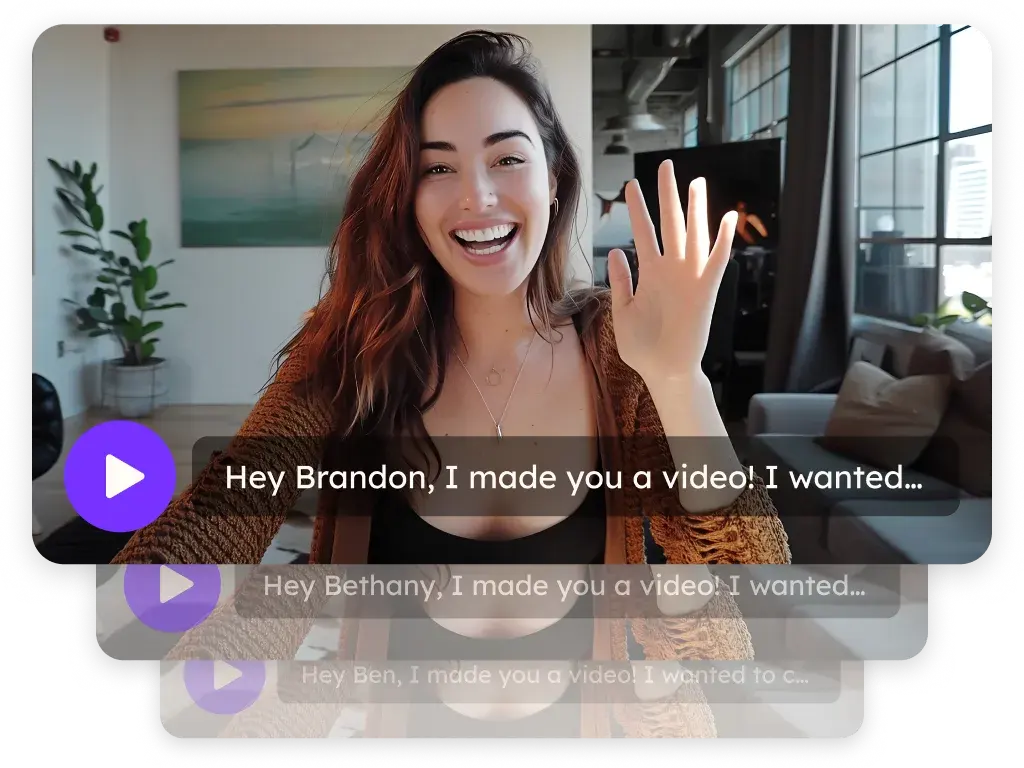
Video prospecting is the practice of using short, personalized videos instead of plain text in cold outreach to start sales conversations. Reps record or AI-personalize a video for each prospect, then send it by email or LinkedIn to stand out, build trust faster, and book more meetings.
Key takeaways
- Video prospecting replaces text-only cold email with a face-to-camera message, making outreach feel personal and harder to ignore.
- According to Wyzowl's Video Marketing Statistics 2026 (266 respondents), 83% of video marketers say video has directly increased sales.
- An AI video personalization platform lets a rep record one video and deliver personalized versions at scale using dynamic backgrounds and AI voice cloning — so volume no longer requires generic outreach.
- Keeping prospecting videos to 30–60 seconds preserves watch-through rate and ensures prospects reach the call-to-action.
- Email and LinkedIn DMs are the highest-performing channels for video prospecting; animated thumbnails linking to a hosted video dramatically outperform static text links.
Why does video prospecting get more replies than cold email?
Video prospecting outperforms plain email because it adds a human face and voice, which prospects find harder to dismiss. Wyzowl's Video Marketing Statistics 2026 reports 83% of video marketers say video directly increased sales — evidence the medium consistently drives stronger commercial outcomes than text alone.
How does an AI video personalization platform make video prospecting scalable?
An AI video personalization platform lets a rep record one base video, then automatically generates individualized versions for each prospect — swapping in names, company websites as dynamic backgrounds, and personalized thumbnails. The result is a bespoke feel for thousands of contacts without recording each video separately.
What video length works best for cold outreach prospecting?
Prospecting videos perform best at 30–60 seconds. That range is long enough to make a relevant point and establish credibility, short enough to maintain watch-through rate. Videos under one minute achieve roughly 66% average completion rate, according to industry benchmarks, ensuring most viewers reach the CTA.
83% of video marketers say video has directly increased sales.
— Wyzowl, Video Marketing Statistics 2026 (12 Years of Data)
Related terms
personalized video · video email · async video · watch through rate
Related reading
Frequently asked questions
How is video prospecting different from a regular sales email?
A regular email is text a prospect skims in seconds; a video prospecting message adds a human face and voice, which raises reply and meeting-booking rates because it feels personal and harder to ignore.
Does video prospecting scale?
Yes. With an AI video personalization platform, a rep records one base video and the platform auto-personalizes it for thousands of prospects using dynamic backgrounds, personalized thumbnails, and AI voice cloning — so scale no longer means generic.
What length should a prospecting video be?
30–60 seconds. Long enough to make a relevant point, short enough to keep watch-through high.
Which channels work best for video prospecting?
Email and LinkedIn DMs see the highest open and reply rates for video prospecting. Embedding an animated thumbnail that links to the video in email dramatically outperforms a static link.
Do I need expensive equipment to start video prospecting?
No. A laptop webcam or smartphone with decent lighting is sufficient for most prospecting videos. Audio quality matters more than resolution — use a quiet space or a basic clip-on mic.
How do I measure whether video prospecting is working?
Track reply rate, meeting-booking rate, and watch-through rate per video. A high view count with low replies usually means the video itself is compelling but the CTA or offer needs adjustment.
Can video prospecting work for enterprise accounts with multiple stakeholders?
Yes. Record a prospect-specific video for the primary contact, then use a digital sales room to house supporting content all stakeholders can access — giving the full buying committee a consistent, trackable experience.
Published June 2026