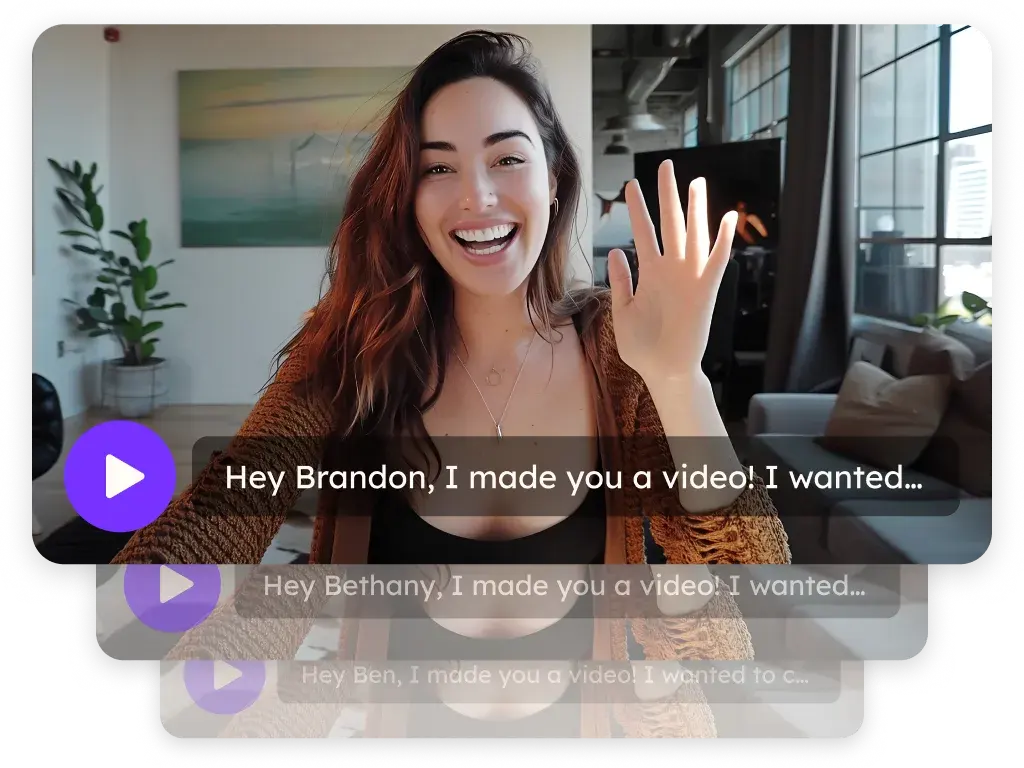
An AI avatar in sales video is a photorealistic digital representation of a person — typically a sales rep or executive — generated by AI from a short recorded sample. The avatar can deliver a spoken script with natural lip-sync and expression, enabling reps to produce personalized video messages at scale without stepping in front of a camera for every send.
Key takeaways
- An AI avatar is generated from a one-time consent recording and can then deliver any script at scale — no additional camera sessions required per send.
- Gartner estimates that in 2025, human-like virtual personas (including AI avatars) will support 70% of digital and marketing communications.
- AI avatars eliminate camera anxiety and ensure consistent on-brand presentation regardless of the rep's location, lighting, or time zone.
- Wyzowl's 2026 State of Video Marketing data shows 63% of video marketers now use AI video tools for creation or editing — up from 51% the prior year — reflecting rapid mainstream adoption.
- AI avatars and AI voice cloning are complementary: the avatar provides the visual likeness and lip-sync while the cloned voice delivers audio in the rep's own sound, producing a complete scalable video.
How is an AI avatar different from a real camera recording for sales outreach?
A real camera recording requires the rep to be physically present, lit, and on camera for every send. An AI avatar is generated once from a consent recording and then delivers any script at any time without additional camera sessions. Gartner estimates human-like virtual personas will support 70% of digital and marketing communications in 2025, signaling that AI-generated presence is entering mainstream sales use.
What is the main business case for AI avatars in B2B sales?
AI avatars let a single rep or small team produce personalized video outreach at a volume that would otherwise require significant headcount. Wyzowl's Video Marketing Statistics 2026 reports 63% of video marketers now use AI tools for video creation or editing — up from 51% the year before — reflecting rapid adoption of AI-generated content in commercial contexts.
How do AI avatars handle consent and ethical use in sales?
Responsible AI video personalization platforms require explicit written consent from the person whose likeness is being modeled before creating an avatar. Enterprise buyers should verify that any platform used for AI avatars enforces consent workflows, maintains audit logs, and prohibits impersonation of third parties — ethical use is a procurement and legal requirement, not just a best practice.
Gartner estimates that in 2025, human-like virtual personas will support 70% of digital and marketing communications.
— Gartner, Market Guide for Digital Humans, 2024
Related terms
personalized video · voice cloning · video prospecting · async video
Related reading
Frequently asked questions
How is an AI avatar different from a real camera recording?
A real camera recording requires the rep to be physically available, lit, and on camera each time. An AI avatar is generated from a one-time consent recording and can then deliver any script at any time without additional camera sessions.
Will prospects know they are watching an AI avatar?
Quality varies by platform. Leading AI video personalization platforms produce avatars with natural micro-expressions and accurate lip-sync that read as authentic in short-form sales videos. Transparency about AI use is a best practice for trust.
What is the main business case for AI avatars in sales?
AI avatars let a single rep — or a small team — produce personalized video outreach at the volume that would otherwise require a large headcount. They also eliminate camera anxiety and ensure consistent on-brand presentation regardless of the rep's location or time zone.
Does an AI avatar work alongside AI voice cloning?
Yes. AI avatars and AI voice cloning are complementary: the avatar provides the visual likeness and lip-sync, while voice cloning delivers the audio in the rep's own voice. Together they produce a scalable video that sounds and looks like the actual rep.
How much source footage does an AI avatar require?
Leading platforms generate a usable avatar from 1–5 minutes of clean, well-lit source footage. Longer, higher-quality samples produce more accurate expressions and lip-sync. A one-time recording session is all that is required before the avatar can deliver unlimited scripts.
What consent requirements apply to AI avatars in sales?
Responsible platforms require explicit written consent before creating an avatar. Creating an avatar without consent is unethical and, under growing regulatory frameworks, potentially illegal. Verify consent workflows before deployment.
Are AI avatars subject to any regulations?
Yes. Several US states require disclosure when AI-generated likenesses are used commercially. The FTC has signaled interest in synthetic media consent. Enterprise teams should review applicable requirements with legal counsel before deploying AI avatars.
Published June 2026