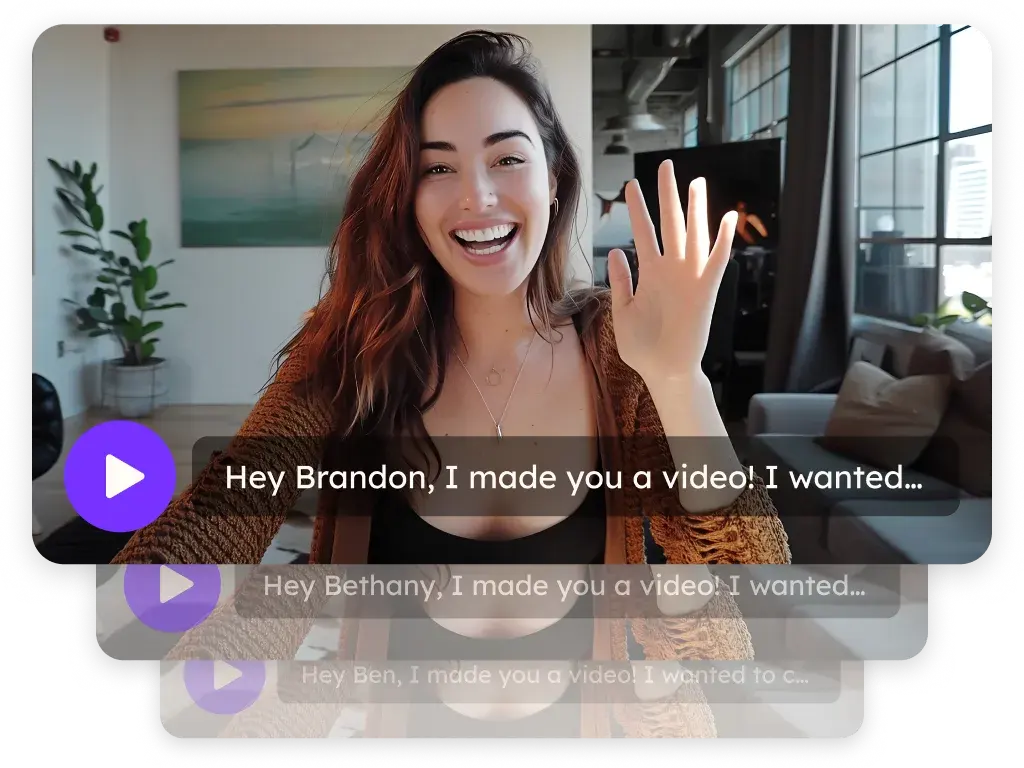
Voice cloning in sales video is the use of AI to synthesize a speaker's voice from a short recorded sample, then generate new speech that sounds like that person saying any script. In an AI video personalization platform, voice cloning lets a rep record a base video once and have the AI deliver personalized audio — pronouncing each prospect's name or company correctly — across thousands of sends.
Key takeaways
- AI voice cloning synthesizes a rep's voice from a short recorded sample and can then deliver any script — including correctly pronouncing unique prospect names — across thousands of personalized sends.
- The FTC launched a Voice Cloning Challenge in January 2024 specifically to develop solutions preventing fraud and misuse of AI voice synthesis, reflecting the regulatory attention this technology carries.
- Leading platforms generate a usable voice clone from as little as 30–60 seconds of clean audio; longer, higher-quality samples produce more natural results.
- Voice cloning and AI avatars are complementary: the avatar provides the visual likeness and lip-sync while the cloned voice delivers audio in the rep's own sound, creating a complete scalable video.
- Responsible AI voice cloning requires explicit consent from the person whose voice is being cloned — impersonating or cloning a voice without consent creates legal and reputational risk.
How does voice cloning make outbound sales video personalization possible at scale?
Personalization at scale requires different audio per recipient — especially for correctly pronouncing unique names and company names. AI voice cloning generates each recipient's specific audio from the rep's trained voice model without requiring re-recording. The FTC's 2024 Voice Cloning Challenge highlights both the technology's rapid maturation and the consent safeguards that responsible platforms must enforce.
How much audio is needed to create a voice clone?
Leading AI platforms can generate a usable voice clone from as little as 30–60 seconds of clean, uninterrupted audio recorded in a quiet environment. Longer recordings — ideally 3–5 minutes covering varied pitch and cadence — produce more accurate, natural-sounding results with fewer synthetic artifacts in the output.
What are the legal and ethical requirements for AI voice cloning in sales?
The FTC issued a November 2023 challenge specifically to address harms from AI-enabled voice cloning, and the FCC confirmed in 2024 that AI-generated voices in phone outreach require prior express consent under the TCPA. Responsible AI video personalization platforms enforce explicit consent workflows — enterprise buyers must verify these controls before deploying voice cloning at scale.
The FTC is taking steps to address the harms of AI-enabled voice cloning, including fraud, the broader misuse of biometric data, and the misuse of creative content.
— Federal Trade Commission, 'Preventing the Harms of AI-Enabled Voice Cloning', November 2023
Related terms
ai avatar · personalized video · video prospecting · async video
Related reading
Frequently asked questions
How much audio does voice cloning require to train on?
Leading platforms can generate a usable voice clone from as little as 30–60 seconds of clean audio. Longer, higher-quality recordings typically produce more accurate and natural-sounding results.
What makes voice cloning valuable in outbound sales?
Personalization at scale requires different audio for each recipient — especially for correctly pronouncing unique names or company names. Voice cloning automates this without requiring the rep to re-record for every contact, dramatically reducing production time.
Is AI voice cloning distinguishable from the real voice?
High-quality voice clones are trained to match the speaker's prosody, tone, and cadence. In short-form sales videos (under 60 seconds), listeners typically cannot distinguish a well-produced clone from the original speaker.
Are there ethical and legal considerations for voice cloning?
Yes. Responsible AI video personalization platforms require explicit consent from the person whose voice is being cloned. Impersonating another individual without consent or using a cloned voice deceptively creates significant legal and reputational risk.
What regulations govern AI voice cloning in commercial sales use?
The FCC confirmed in 2024 that AI-generated voices in phone outreach require prior consent under the TCPA. The FTC's Voice Cloning Challenge (January 2024) signals ongoing regulatory attention. Enterprise legal teams should audit applicable requirements before deployment.
Can a rep's voice be cloned without their knowledge?
Responsible platforms require explicit written consent before creating a voice model. Cloning a voice without consent is unethical and, under growing regulatory frameworks, potentially illegal. Verify consent enforcement before selecting any platform.
How does AI voice cloning handle unusual or non-English names?
Voice cloning models generate audio from phonetic text input, allowing accurate pronunciation of uncommon prospect or company names — a key practical advantage over a single static recording that cannot adapt per contact.
Published June 2026