vs
vs

Sendspark vs Dubb: Which Video Sales Platform Is Right for Your B2B Team?
TL;DR Verdict
Sendspark is built for B2B sales teams that need AI-powered video personalization at scale — record once, send personalized videos to hundreds of prospects automatically. Dubb is a solid video messaging platform with strong landing page and CTA overlay features, better suited for teams that prioritize video sales rooms and lead capture over AI personalization. If AI-driven outreach at scale is your goal, Sendspark wins clearly.
How We Evaluated
We compared Sendspark and Dubb across five criteria: AI personalization capabilities, pricing structure for sales teams, CRM integration depth, video delivery features, and fit for high-volume outbound workflows. Ratings are sourced from verified G2 reviews (2025–2026) and publicly available pricing pages. Both platforms were evaluated from the perspective of B2B sales teams sending video at scale.
Feature Comparison: Sendspark vs Dubb
Both Sendspark and Dubb are purpose-built video messaging tools for sales teams — which makes this a closer comparison than most. They share a core capability set: video recording, personalized delivery, analytics, and CRM integrations. The gap opens decisively when you look at AI personalization depth and how each platform handles scale.
| Feature | Sendspark | Dubb |
|---|---|---|
| Video recording (webcam + screen) | ✅ | ✅ |
| AI video personalization at scale | ✅ | ❌ |
| AI voice cloning | ✅ | ❌ |
| Dynamic prospect backgrounds (website/LinkedIn) | ✅ | ❌ |
| Combined video (intro + demo) | ✅ | ❌ |
| Video analytics (per-recipient) | ✅ | ✅ |
| CRM integration (HubSpot, Salesforce) | ✅ (5/5 G2) | ✅ (Limited) |
| Sales sequence automation (Outreach, SalesLoft, Apollo) | ✅ | Limited |
| Video landing page builder | Limited | ✅ |
| CTA overlays on video | ✅ | ✅ |
| Video sales rooms | ❌ | ✅ |
| Lead capture forms | Limited | ✅ |
| 50+ sales/marketing integrations | ✅ | Limited |
| Free plan | 7-day trial | ✅ (5 videos) |
The core difference in one sentence: Dubb lets you build polished video experiences with landing pages and overlay CTAs. Sendspark lets you scale personalized video outreach with AI — recording once and automatically generating unique videos for every prospect on your list.
Pricing Comparison: Sendspark vs Dubb
Dubb offers a free entry point (limited to 5 videos) and paid plans starting at $42/month — priced competitively for individual sales reps. Sendspark starts at $49/month with AI features included. For teams, the pricing structures diverge significantly based on what you need.
| Plan | Sendspark | Dubb |
|---|---|---|
| Free | 7-day trial (all features) | $0/mo — 5 videos, 1 seat |
| Solo / Pro | Solo — $49/mo (1 seat, 5K videos, 100 AI credits) | Pro — $42/mo (1 seat, unlimited videos) |
| Small team | Growth — $99/mo (3 seats, API access, agentic workflows) | Growth — $68/mo (3 seats, unlimited videos) |
| Full team | Team — $299/mo (10 seats, advanced integrations, dedicated onboarding) | Enterprise — Custom pricing |
| Enterprise | Custom (SOC 2, RBAC, custom integrations) | Custom |
At the solo rep level, Dubb's Pro plan ($42/mo) is slightly cheaper than Sendspark's Solo plan ($49/mo). But for teams of 10, Sendspark's flat $299/month Team plan is often more economical than Dubb's per-seat enterprise pricing. The real differentiator is what you're paying for: Sendspark's plans include AI personalization credits and agentic workflows; Dubb's plans focus on video delivery infrastructure and landing page features.
Watch for AI credit limits: Sendspark's Solo plan includes 100 AI personalization credits/month. Teams doing high-volume outreach (100+ personalized videos/week) should evaluate the Growth or Team plans, which include substantially higher AI credit allocations.
Key Differentiators: Where Each Platform Wins
Where Sendspark Wins
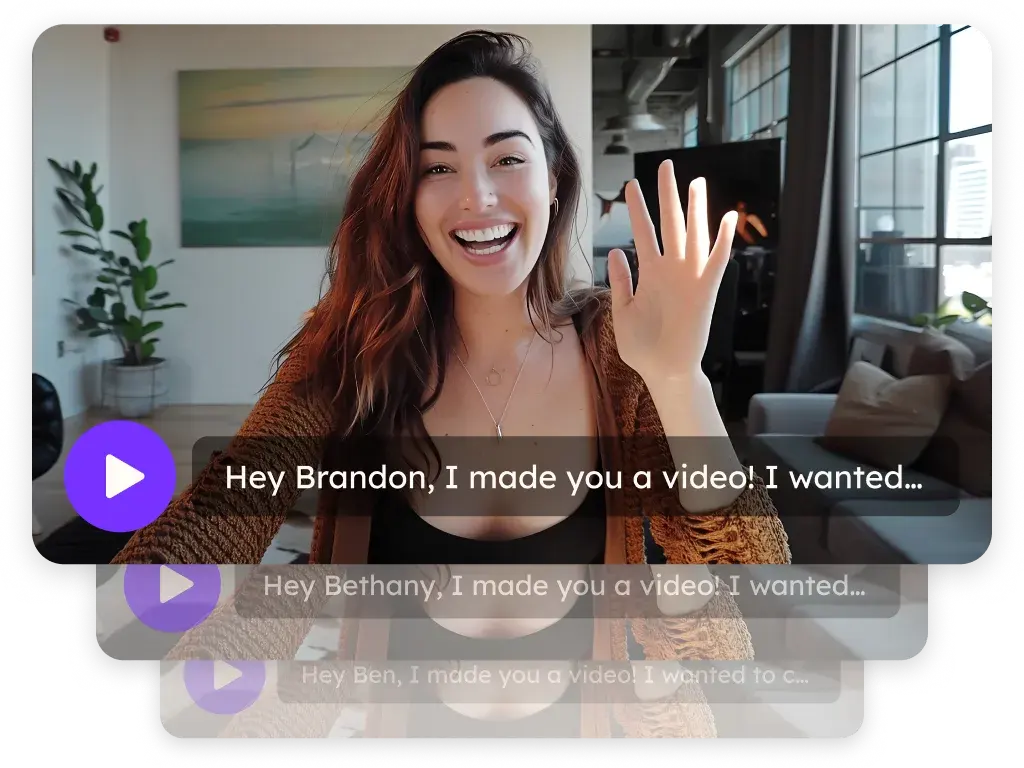
AI personalization at scale is Sendspark's defining advantage. Record a single video, and Sendspark's AI generates a unique version for every prospect on your list — with their name spoken in your voice, their company mentioned, and their website displayed as a live background behind you. Dubb has no equivalent capability.
According to Salesforce's State of Sales report, sales reps spend 70% of their time on non-selling activities. Sendspark directly attacks this problem: teams using Sendspark's AI personalization report saving 10+ hours per campaign compared to recording individual videos. At scale — 200+ prospects per week — this isn't a feature difference, it's a workflow transformation.
CRM integration depth is a clear Sendspark advantage. Sendspark's HubSpot integration is rated 5/5 on G2, with bi-directional sync that writes video engagement data (opens, plays, watch time, CTA clicks) back to contact records and deals automatically. Dubb offers CRM integrations, but G2 reviewers consistently note that Sendspark's HubSpot and Salesforce sync is more reliable and deeper. For teams whose reps live in their CRM, this matters every day.
Sendspark connects to 50+ sales and marketing platforms — Outreach, SalesLoft, Apollo, Clay, ZoomInfo, and more. This means video can be triggered from any point in your existing sequence workflows. Dubb's integration ecosystem is smaller, focusing primarily on CRM and email, without the same breadth of sequence automation connections.
The combined video workflow is unique to Sendspark. The platform lets you merge a short personalized intro — recorded once with AI variations per recipient — with a reusable product demo or explainer. The result is a single cohesive video that feels fully custom but takes a fraction of the time to produce. For AEs demoing a product to 50+ prospects in a pipeline, this is a significant time advantage over any approach requiring individual recordings. Dubb has no equivalent combined video capability.
Where Dubb Wins
Dubb's video landing page builder is genuinely stronger. Dubb lets you create fully branded, customizable landing pages for each video — with embedded lead capture forms, CTA buttons, and company branding — without needing a separate website or developer. Sendspark's video pages are functional but more limited in layout customization. If building polished, standalone video destinations is a priority, Dubb has the edge.
Video sales rooms give Dubb a mid-funnel advantage. Dubb's sales room feature lets you create a shared space where prospects can view multiple videos, resources, and materials in one branded URL. This is useful for complex B2B deals with multiple stakeholders. Sendspark doesn't offer a comparable sales room feature, focusing instead on outbound outreach and initial engagement.
Overlay CTAs on video are more flexible in Dubb. Dubb lets you layer clickable buttons, forms, and calendar links directly onto the video frame — at any timestamp during playback. This makes it easy to drive a specific action (book a meeting, download a resource) exactly when a viewer is most engaged. Sendspark supports CTA buttons on video pages, but the in-video overlay depth at specific timestamps is more limited.
Dubb's free plan is a genuine entry point. The free tier allows 5 videos — enough for a sales rep to test the platform in real outreach before committing. Sendspark's 7-day free trial gives you full access but requires a card and has a time limit. For teams with strict approval processes around new tools, Dubb's freemium model removes one barrier to initial adoption.
See AI personalization in action
Record once, send personalized videos to every prospect on your list — automatically.
Try Sendspark Free →Which Should You Choose?
Both tools are legitimate choices for B2B sales teams. The right fit depends on your primary use case and the scale at which you operate.
Choose Sendspark if you:
- Send 50+ outbound video emails per week and need to personalize each one without recording individually
- Run HubSpot or Salesforce as your CRM and need video engagement data to flow back automatically into deal records
- Use Outreach, SalesLoft, or Apollo for sequencing and want video embedded in your existing workflows
- Want AI voice cloning to generate personalized spoken greetings at scale
- Have a team of SDRs or BDRs doing high-volume outbound prospecting
- Need a Vidyard alternative or BombBomb alternative with stronger AI capabilities
Choose Dubb if you:
- Need a polished video landing page with embedded lead capture forms for each video you send
- Work complex, multi-stakeholder deals and want a video sales room to centralize content for a buying committee
- Want to test video outreach for free before committing to a paid plan (Dubb's free tier allows 5 videos)
- Send lower video volume (under 20/week) where AI personalization at scale isn't a priority
- Need strong overlay CTA features — clickable buttons, forms, and calls-to-action layered directly onto the video player
Pro tip for high-volume teams: If your team sends more than 100 videos per month and you're manually personalizing each recording, that's the inflection point where Sendspark's AI personalization pays for itself — both in hours saved and in the response rate lift from genuine personalization at scale.
What Real Users Say
Sendspark and Dubb both earn strong G2 ratings — 4.8 and 4.6 respectively — but user reviews reveal distinct strengths. Sendspark reviewers consistently highlight AI personalization and CRM integration as the features that drove adoption. Verified G2 users frequently describe the "record once, personalize for everyone" workflow as a time-saver that changed how their SDR teams operate, with several noting that HubSpot sync eliminated manual data entry entirely.
Dubb users praise the platform's video landing pages and CTA overlay flexibility — reviews commonly mention being able to create branded video pages that feel like a dedicated website, without needing a developer. Users in longer sales cycles report that the sales room feature helped move deals forward by giving multi-stakeholder buying committees a single URL with all relevant video content organized clearly.
Where Dubb receives critical feedback: reviewers note that AI personalization capabilities are limited compared to competitors, and that the integration ecosystem is narrower than platforms focused on the modern outbound sales stack. Some reviewers also point to a learning curve with Dubb's landing page builder — the flexibility comes with setup complexity that can slow initial adoption for reps who just want to record and send quickly.
Sendspark's criticism centers on its video editing tools — reviewers note they're functional for sales use cases but don't match the editing depth of tools designed primarily for video production. Reviewers who switched from Dubb to Sendspark consistently cite three reasons: AI personalization at scale, stronger HubSpot sync, and the ability to plug into existing Outreach or Apollo sequences without rebuilding workflows.
How to Switch from Dubb to Sendspark
Switching from Dubb to Sendspark is straightforward for most sales teams. Here's what transfers and what requires rebuilding:
What transfers easily:
- Video library — Download your existing videos from Dubb and re-upload to Sendspark's library. Most video files transfer without quality loss.
- Contact lists — Export your recipient lists from Dubb as CSV and import into Sendspark. HubSpot contact sync will handle ongoing contact management.
- CRM connections — Re-authenticate your HubSpot or Salesforce connection in Sendspark settings. The deeper bi-directional sync typically takes 15–30 minutes to configure.
What requires rebuilding:
- Video landing pages — Dubb's custom landing page designs don't transfer. Sendspark uses its own video page templates; plan 1–2 hours to recreate your branded pages.
- Automation workflows — Any Dubb-specific automations need to be rebuilt in Sendspark using the Outreach, SalesLoft, or Apollo integrations, or via Sendspark's native workflow builder.
- AI training (voice cloning) — Record a 2-minute voice sample in Sendspark to activate AI voice cloning. This is a one-time setup that takes under 10 minutes.
Estimated migration time: 2–4 hours for a solo rep; 1–2 days for a team of 10 with complex CRM and sequence integrations. Most teams see their first AI-personalized campaign live within 24 hours of switching. Learn more about Sendspark's core features or explore the full integrations list before you start.
If you're comparing other video messaging tools in the same category as Dubb, see our detailed breakdowns: Sendspark vs BombBomb, Sendspark vs Hippo Video, and Sendspark vs Vidyard. All three cover similar use-case segmentation and migration considerations. You can also explore the full Sendspark resources library for onboarding guides and sales video best practices.
Frequently Asked Questions
Is Sendspark better than Dubb for B2B sales outreach?
Sendspark is the stronger choice for high-volume B2B outbound outreach, thanks to AI personalization at scale, deeper HubSpot/Salesforce integration, and sales sequence automation. Dubb is competitive for teams prioritizing video landing pages and sales rooms over AI-driven personalization.
Does Dubb have AI video personalization?
Dubb does not offer AI video personalization comparable to Sendspark. Sendspark's AI can automatically generate personalized greetings with your cloned voice, swap dynamic backgrounds per prospect, and combine intro videos with reusable demo content — none of which Dubb currently supports.
How does Sendspark vs Dubb pricing compare for a team of 5?
For a team of 5, Sendspark's Growth plan ($99/mo, 3 seats) plus additional seats, or Team plan ($299/mo, 10 seats), typically compares favorably to Dubb's Growth plan ($68/mo for 3 seats) once AI credit usage and integration depth are factored in. Dubb is cheaper at the entry level; Sendspark delivers more value at scale.
Can I use both Sendspark and Dubb together?
Yes — some teams use Sendspark for high-volume AI-personalized outbound outreach and Dubb for mid-funnel deal acceleration with sales rooms and custom landing pages. However, most teams find one platform sufficient and consolidate to reduce stack complexity and cost.
Does Sendspark integrate with HubSpot better than Dubb?
Sendspark's HubSpot integration is rated 5/5 on G2 with bi-directional sync — video plays, watch time, and CTA clicks automatically update contact and deal records. Dubb offers HubSpot integration but with shallower sync depth. For HubSpot-centric sales teams, Sendspark is the stronger native integration.
Which platform has better video analytics — Sendspark or Dubb?
Both platforms provide per-recipient video analytics (opens, plays, watch time). Sendspark's analytics feed directly into HubSpot/Salesforce records and can trigger automated follow-up sequences based on engagement signals. Dubb's analytics are strong but less deeply connected to CRM deal workflows.
What are the best Dubb alternatives for sales teams?
The top Dubb alternatives for B2B sales teams are Sendspark (best for AI personalization at scale), Vidyard (best for video hosting and marketing integration), BombBomb (best for relationship-driven email video), and Hippo Video (best for budget-conscious teams). See the full comparison hub for detailed breakdowns.
Sources & References
- G2 — Sendspark Reviews — 4.8/5 rating from 350+ verified reviews, including HubSpot integration rated 5/5 (2025–2026)
- G2 — Dubb Reviews — 4.6/5 rating from 550+ verified reviews (2026)
- Salesforce — State of Sales Report — Sales reps spend approximately 70% of time on non-selling activities (2024)
Ready to personalize video outreach at scale?
Join 50,000+ companies using Sendspark's AI to turn one recording into hundreds of personalized videos — automatically.
Get Started Free →No credit card required • Set up in 2 minutes
Explore More Comparisons
- Sendspark vs Vidyard — Compare AI personalization vs video hosting for sales teams
- Sendspark vs BombBomb — Compare AI-powered outreach vs relationship video email
- Sendspark vs Hippo Video — Compare sales video platforms for SMBs
- Sendspark vs Loom — Sales outreach vs async communication
- ← Back to all comparisons
Updated August 2026