vs

Sendspark vs Sendr: An All-in-One Outbound Suite or a Best-in-Class Video Layer?
Updated September 2026
The short answer
Sendr is an all-in-one outbound platform that finds contacts, sends sequences across email, LinkedIn and WhatsApp, and adds lipsync video. Sendspark is an AI video personalization platform that plugs into the sequencer you already run. Choose Sendr to replace your stack. Choose Sendspark when the video itself has to carry the message.
These two products get compared often, and the comparison is usually framed wrong. Sendspark and Sendr are not two versions of the same tool. They solve different halves of the same problem, and the honest question is not which one is better but which half you are actually missing.
Sendr consolidates. It gives you a contact database, enrichment, a native multichannel sequencer, a unified reply inbox and a video feature, all from one vendor on one bill. Sendspark specializes. It does not find contacts and it does not send your sequences. It makes the video in the sequence worth watching, using AI voice cloning and dynamic backgrounds, and then hands it to HubSpot, Salesforce, Outreach, Smartlead or whatever else you already run.
If you are building outbound from nothing and want one vendor, that is a genuine argument for Sendr and we will make it below. If you already own a sequencer and a data provider, adding Sendr means replacing working parts of your stack to get the video, and that is a poor trade.
4.8/5
Sendspark on G2
350+ reviews. 50,000+ campaigns. Founded 2019.
4.9/5
Sendr on G2
10 reviews. Launched 2025. 4.1/5 from 48 AppSumo reviews.
Both scores are high, and they are not measuring the same thing. A 4.9 average across 10 reviews is a strong early signal from a small group of engaged users. A 4.8 average across more than 350 reviews is a distribution: it has absorbed the unhappy customers, the edge-case deployments and the people who churned. When you are committing a sales team to a tool, the size of the sample matters as much as the number.
Sendr's larger public review base is on AppSumo, where it holds 4.1 out of 5 from 48 reviews. That is the more representative sample of the two, and it is worth reading before you buy.
How We Evaluated These Tools
We compared both products on feature coverage, published pricing, third-party review data, integration ecosystem and use-case fit, using each vendor's own public documentation and pricing pages as the source of record. Figures were taken directly from sendr.ai and sendspark.com in September 2026. Where a vendor's own properties disagree with each other, we say so rather than picking the flattering number.
We have obvious skin in this game. The correction for that is to be specific and checkable: every claim below is sourced, and the section on where Sendr beats us is not decorative.
Feature Comparison
| Capability | Sendspark | Sendr |
|---|---|---|
| AI voice cloning of the rep | ✓ | ✓ |
| Dynamic prospect-website background | ✓ | ✓ |
| Visual lipsync personalization | ✓ (beta) | ✓ |
| Personalized thumbnails / GIF previews | ✓ | ✓ |
| Personalized landing pages | ✓ | ✓ |
| B2B contact database | ✗ | ✓ |
| Email and mobile enrichment | ✗ | ✓ |
| Native sequencer (sends the outreach) | ✗ | ✓ |
| Native in-app video DMs (LinkedIn, WhatsApp) | ✗ | ✓ |
| Unified reply inbox | ✗ | ✓ |
| Per-recipient video analytics | ✓ | ✓ |
| Bi-directional CRM sync | ✓ | ✓ |
| Integrations | 50+ native | Native HubSpot, Salesforce, Attio and more, plus API |
| Implementation time | Minutes to first video | Onboarding a full motion |
| Data and sending included | ✗ | ✓ |
| Support at entry price | Email support | Not stated on Sendr's pricing page |
| Security posture | SOC 2 Type 2 | ISO 27001:2022 |
| Track record | Since 2019 · 50,000+ campaigns | Launched 2025 |
Read the table this way. Almost every row where Sendr wins is about reaching the prospect. Almost every row where Sendspark wins is about what happens once you have their attention. That is the whole comparison in one line.
Pricing Compared
The headline numbers look close. What they buy is not.
| Plan | Sendspark | Sendr |
|---|---|---|
| Entry plan | $49/mo Solo · 1 seat · ~600 videos/mo (100 dynamic min) | $99/mo, or $79/mo billed annually · 3,000 credits/mo · 2 sending channels |
| Most popular | $99/mo Growth · 3 seats · ~1,500 videos/mo (250 dynamic min) | — |
| Mid tier | $299/mo Team · 10 seats · ~6,000 videos/mo (1,000 dynamic min) | — |
| Top standard | $699/mo Business · 25 seats · ~18,000 videos/mo (3,000 dynamic min) | — |
| Annual option | $828 to $5,988/yr by tier | $948/yr ($79/mo billed annually, 20% off) |
| Done-for-you | — | Not listed on Sendr's pricing page |
| Overage | $0.39 to $0.19 per dynamic minute, about $0.03 to $0.07 per extra video | +$10/mo per extra 1,000 credits or sending channel |
| Contact data and sending | Not included, bring your own | Included |
| Free trial | 7 days, no card | 14 days, 1,500 credits, no card |
Why the video counts look so different
Sendspark meters personalization by the minute rather than by the video, and the two products are usually compared on the wrong unit. Dynamic video minutes are consumed as personalized length multiplied by recipients, so a 10-second personalized intro is six videos per minute. On Growth, 250 minutes is roughly 1,500 personalized videos a month.
The part that surprises people: in a combined video, only the first segment counts. You attach your 10-second personalized intro to a longer reusable demo, and the demo costs nothing against your allocation. The prospect watches a full 30 to 45 second video, which is the length we recommend for outbound, while only the intro meters.
So compare like for like. Sendr's single plan includes 3,000 credits a month, and its pricing page doesn't say how many lipsync videos those credits buy, so test your real volume during the trial. Sendspark Growth at $99 works out to roughly 1,500 videos, and Solo at $49 to roughly 600. Longer personalized intros reduce those numbers proportionally: a 30-second intro on Growth is about 500 videos rather than 1,500.
Two things are easy to miss. First, Sendr is one plan: $99 a month, or $79 a month billed annually ($948 a year), with 3,000 credits and two sending channels. Extra credits and channels are $10 a month each, so model your volume before comparing tiers.
Second, Sendspark's entry price does not include data or sending, because Sendspark does not do data or sending. Compare total spend, not sticker price. If you are paying for Apollo or ZoomInfo and Smartlead or Outreach already, Sendr's bundle may not save you anything, since you would be paying for capabilities you own. If you are paying for none of them, Sendr's bundle is genuinely cheaper than assembling the equivalent.
Sendspark's per-minute overage falls as you scale, from $0.39 on Solo to $0.19 on Business. Sendr meters in credits and lipsync videos. Neither model is better in the abstract. Model your actual volume against both before committing, and see our pricing page for the current tiers.
Where Each Tool Genuinely Wins
Where Sendr wins
It finds the contacts. Sendr ships a B2B contact database with verified emails and mobile numbers, plus enrichment and ICP scoring. Sendspark has nothing equivalent, and no plan to build it. If sourcing contacts is your bottleneck, Sendspark does not solve that problem at any price.
It sends the outreach. Sendr's native sequencer runs campaigns across email, LinkedIn and WhatsApp with a unified reply inbox. Sendspark produces the video and hands it to your sequencer. If you do not have a sequencer, that handoff has nowhere to go.
Video plays inside the conversation. This is Sendr's sharpest advantage and it deserves to be stated plainly. Sendr delivers video and voice messages that play natively inside LinkedIn and WhatsApp, with no link to click. Every Sendspark video reaches the prospect as a link. A click is a step where people drop, and removing it is a real edge.
Where Sendspark wins
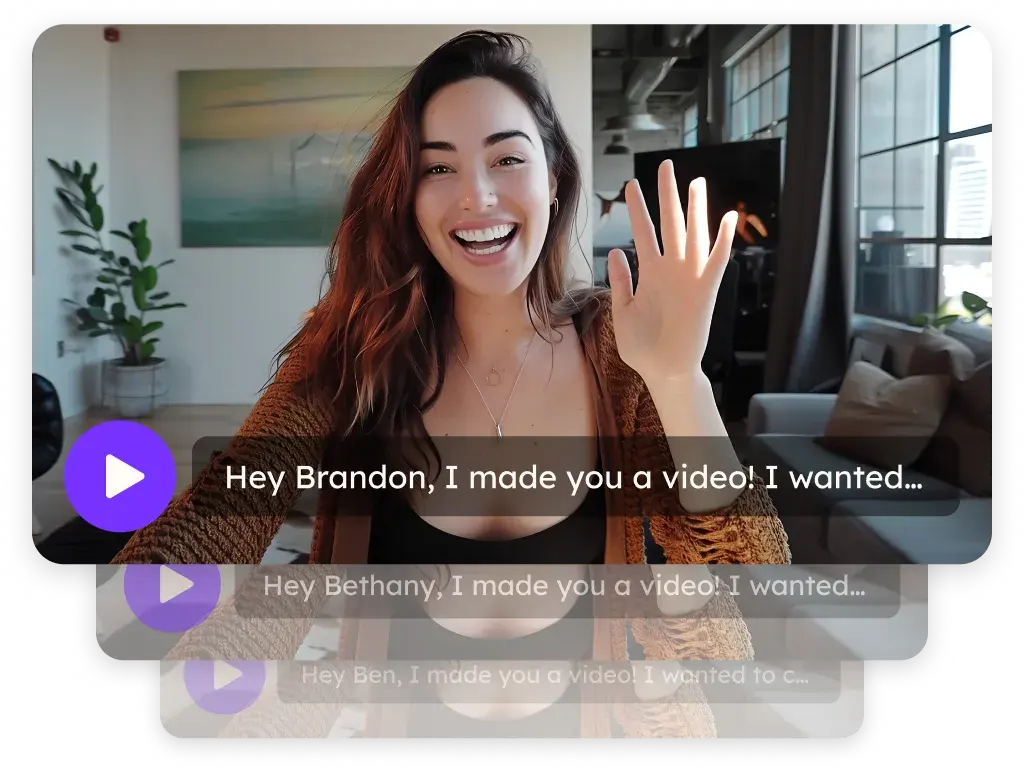
The personalization is the whole product. Sendspark clones your voice and puts the prospect's actual website behind you while you speak. Sendr also lists voice cloning and website backgrounds alongside its lipsync word replacement, so compare the finished videos side by side during both free trials rather than on a feature list. For an owner or an operator who recognizes their own homepage on screen, that personalization is what makes a video feel made for them.
It strengthens the stack you already run. Sendspark connects to HubSpot, Salesforce, Outreach, SalesLoft, Apollo, Smartlead and 90+ other tools, with bi-directional CRM sync so per-recipient video engagement lands on the contact record. You keep your sequencer, your data provider and your reporting. Browse the full integration list to check yours.
The track record is longer. Sendspark has been shipping since 2019, has powered 50,000+ campaigns, holds 4.8 out of 5 across more than 350 G2 reviews, and carries a SOC 2 Type 2 attestation. Sendr launched in 2025 and holds ISO 27001:2022. Both are legitimate security postures. If your security review asks specifically for SOC 2 Type 2, that is worth checking early.
Video quality is the product, not a feature. Sendspark's engineering goes into one thing. Sendr's is spread across a database, a sequencer, an inbox, landing pages and video. At least one AppSumo reviewer called Sendr's dubbing quality a deal breaker, which is the risk of a video feature inside a much larger product.
See what deep personalization actually looks like
Record one video. Your cloned voice greets each prospect by name, with their website behind you.
Try Sendspark Free →Which Should You Choose?
Choose Sendspark if
- You already run a sequencer (Outreach, SalesLoft, Smartlead, Apollo, HubSpot Sequences) and want the video in it to be worth watching
- You already have a data source and sourcing contacts is not your bottleneck
- Your prospects are owners or operators who will recognize their own website on screen
- You need per-recipient video engagement flowing back into HubSpot or Salesforce automatically
- Procurement asks for SOC 2 Type 2 and a multi-year operating history
When to choose Sendr instead
There are clear cases where Sendr is the better buy, and pretending otherwise would waste your time.
- You have no outbound stack yet. If you need contacts, sending and video, and you have none of them, Sendr gets you running on one bill. Assembling Sendspark plus a data provider plus a sequencer costs more and takes longer.
- Finding contacts is the actual problem. If your list is the bottleneck, Sendspark does not help. Sendr's Lead Finder addresses it directly.
- LinkedIn or WhatsApp is your primary channel. Sendr's native in-app video and voice DMs have no Sendspark equivalent today. If you live in LinkedIn DMs, that matters more than personalization depth.
- You want fewer vendors. One contract and one bill is a legitimate reason to buy, especially for a small team without ops support.
Test the database before you commit to it. Sendr's contact data is the main reason to buy the bundle, so verify it covers your specific market. Their stated database size differs across their own properties: 550M+ and 500M+ on the same pricing page, and 479M+ in their own Sendspark comparison post. Pull 100 contacts in your exact ICP during the free trial and count how many have valid emails. Coverage of enterprise SaaS tells you nothing about coverage of local service businesses.
What Reviewers Actually Say
A note on method. Sendr launched in 2025 and has 10 G2 reviews, so there is no meaningful body of public accounts from people who have used both tools. We are not going to invent one. What follows is real sentiment from each product's largest public review base, which for Sendr is AppSumo rather than G2.
Sendr's AppSumo reviewers consistently praise the data and the multichannel reach. AppSumo's AI summary of the reviews highlights "robust multichannel outreach capabilities" and "impressive lead filtering," and one reviewer notes that the "list building/finder B2B/B2C of 520M rocks." Several mention that the founders are active and responsive in the community, which is a real advantage of buying from a small, young vendor.
The recurring criticisms are support response times, bugs and a steep setup. Video gets mixed comments. One two-taco review describes "terrible dubbing quality" and results that were "extremely poor," and reports that "once you become a paying customer, you are left waiting a very long time." Another reviewer praises "smooth lip-sync video stating the name of the prospect." On Product Hunt, where Sendr holds 4.8 from 4 reviews, the praise centers on lead sourcing and consolidation, with one reviewer asking for "deeper integrations with existing sales stacks."
The pattern is worth taking seriously: the data and sequencing side is what people rate most highly, and the video output is where opinions split, so test it on your own footage during the trial. Compare that with Sendspark, which holds 4.8 out of 5 across more than 350 G2 reviews with the video output and CRM integration as the most cited strengths.
Switching Between Sendspark and Sendr
Because these tools do different jobs, "migration" usually means one of two quite different projects.
Adding Sendspark alongside an existing stack
This is the simpler direction and it is not really a migration. Connect Sendspark to your CRM and sequencer, clone your voice once, record your first video, and start dropping personalized videos into the sequences you already run. Nothing else in your stack changes. Most teams send their first personalized campaign the same day.
Moving from Sendr to Sendspark
Plan for this properly, because you are unbundling. Sendspark replaces Sendr's video, and nothing else. Before you move, decide where contact data and sending will come from, since Sendspark provides neither.
- What transfers: your contact lists, by export to CSV or through your CRM. Your video scripts and messaging.
- What does not transfer: Sendr's enrichment credits, sequences, Unibox reply history and lipsync renders. Rebuild sequences in whichever sequencer you adopt.
- What you will need to add: a data provider if you relied on Lead Finder, and a sequencer if you relied on Sendr to send.
- Re-record rather than convert. Sendspark's approach needs one clean camera recording so voice cloning and dynamic backgrounds have something to work with. Budget an afternoon.
- Realistic timeline: a day if you already own a sequencer and a data source, one to two weeks if you need to select and implement them.
The honest summary: if Sendr's bundle is working for you and the video quality is good enough for your market, switching to Sendspark means taking on more vendors. Do it when video performance is the thing holding your outreach back, not out of general dissatisfaction.
Frequently Asked Questions
What is the main difference between Sendspark and Sendr?
Sendr is an all-in-one outbound platform with a contact database, a sequencer and video. Sendspark is an AI video personalization platform that plugs into the sequencer you already use. Sendr replaces your stack; Sendspark upgrades one part of it.
Does Sendspark find contact email addresses like Sendr does?
No. Sendspark has no contact database and does not do email lookup. You import contacts by CSV, from your CRM, or through integrations with Apollo, Smartlead, HubSpot, Salesforce and Outreach. Sendr includes a B2B database and enrichment.
Can Sendspark send email sequences?
No. Sendspark creates personalized videos and delivers them into the sequencer you already run, such as Outreach, SalesLoft, Smartlead or HubSpot. Sendr has its own native sequencer across email, LinkedIn and WhatsApp.
Is Sendspark vs Sendr really a fair comparison?
Only partly. They overlap on personalized video and landing pages. They do not overlap on contact data or sending, where Sendr does things Sendspark does not attempt. Compare them on the job you actually need done.
Which has better video personalization, Sendspark or Sendr?
Both personalize beyond a name. Sendspark uses AI voice cloning and the prospect's own website as a dynamic background, with lip sync available in beta. Sendr uses visual lipsync to swap a word or phrase and also lists voice cloning and website backgrounds. AppSumo reviews of Sendr's video are mixed, so test both on your own footage.
How do the G2 ratings compare?
Sendspark holds 4.8 out of 5 from more than 350 G2 reviews. Sendr holds 4.9 out of 5 from 10 G2 reviews, and 4.1 out of 5 from 48 AppSumo reviews. The AppSumo sample is the larger and more representative one for Sendr.
Which is cheaper, Sendspark or Sendr?
Sendspark starts at $49 per month and Sendr at $99 per month ($79 billed annually), but Sendspark does not include data or sending. Compare total stack cost. If you already pay for a sequencer and a data provider, Sendspark is usually cheaper overall.
Ready to make the video in your sequence worth watching?
Record one video. Sendspark clones your voice and personalizes it for every prospect, then drops it straight into the tools you already use.
Get Started Free →No credit card required • Set up in 2 minutes
Sources & References
- Sendr pricing page (accessed October 2026) for plan pricing, credits, channels, add-ons and trial.
- Sendr homepage (accessed September 2026) for feature set, database claims and ISO 27001 certification.
- Sendr reviews on AppSumo (accessed September 2026), 4.1 out of 5 from 48 reviews.
- Sendr reviews on G2 (accessed September 2026), 4.9 out of 5 from 10 reviews.
- Sendr reviews on Product Hunt (accessed September 2026), 4.8 out of 5 from 4 reviews.
- Sendspark reviews on G2 (accessed September 2026), 4.8 out of 5 from 350+ reviews.
- Sendspark pricing (accessed September 2026) for tiers, seats, dynamic video minutes and overage rates.
Related Comparisons
Evaluating more than one option? These may help:
- Sendspark vs Vidyard, for enterprise video platforms
- Sendspark vs Loom, if async team communication is also in scope
- Sendspark vs BombBomb, another sales-focused video comparison
- Sendspark vs Hippo Video, for sales video automation
- Sendspark vs Dubb, for video plus outreach features
- Sendspark vs HeyGen, if AI avatars are on your list
- Sendspark vs Tavus, for AI-generated video at scale
- See all Sendspark comparisons
- Explore Sendspark features or book a demo